
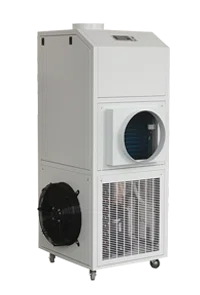
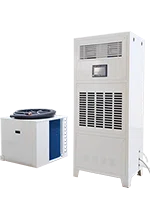
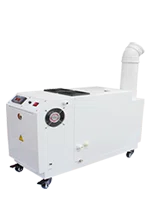
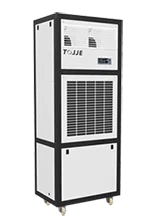
How Wet Film Humidifiers Support Battery Production Environments
Battery manufacturing requires carefully controlled production environments. Temperature, relative humidity, air cleanliness, and electrostatic conditions can all influence manufacturing processes and workplace conditions.
For lithium-ion battery production in particular, different manufacturing stages may require very different environmental conditions. Some areas require extremely low humidity, while other production or storage areas may benefit from controlled humidity to reduce static electricity, protect materials, and maintain stable working conditions.
Wet film humidifiers can provide controlled moisture addition in suitable battery manufacturing environments. By introducing water vapor through an evaporative process, these systems can help maintain target relative humidity levels in areas where humidification is appropriate.
Humidity Control for Battery Material Handling
Battery production involves the handling of various materials, including:
-
Electrode materials
-
Separators
-
Polymer components
-
Packaging films
-
Electronic components
-
Powders and granulated materials
Environmental conditions can affect the behavior and handling characteristics of some materials.
Stable humidity can help create a more predictable production environment, particularly in areas where excessive dryness causes static or material-handling challenges.
The appropriate humidity level should always be determined according to the specific material and manufacturing process.
Wet Film Humidifiers and Battery Manufacturing HVAC Systems
Wet film humidifiers can be integrated into air handling units (AHUs) and industrial HVAC systems.
A typical configuration may include:
Outdoor air / return air → Filtration → Cooling or heating → Wet film humidification → Conditioned air → Production area
Sensors can continuously monitor:
-
Relative humidity
-
Temperature
-
Airflow
-
Water level
-
Humidifier operating status
The HVAC control system can then adjust humidification output according to the environmental requirements.
Energy Efficiency of Wet Film Humidification
Energy consumption is an important consideration for large battery manufacturing facilities.
Evaporative humidification can use the energy contained in the air stream to facilitate water evaporation, potentially reducing the direct energy requirement associated with electrically generating steam.
The actual energy efficiency depends on:
-
Air temperature
-
Relative humidity
-
Airflow
-
Water temperature
-
Humidifier design
-
HVAC configuration
-
Required humidity increase
For this reason, wet film humidifiers may be considered when designing energy-conscious industrial humidity-control systems.
Water Quality and Maintenance Considerations
Water quality is an important factor in wet film humidification systems.
Minerals and impurities in the water can accumulate on wetted surfaces and affect system performance.
Regular maintenance may include:
-
Cleaning humidification media
-
Inspecting water distribution systems
-
Checking drainage
-
Monitoring water quality
-
Inspecting pumps and valves
-
Replacing worn components
-
Checking humidity sensors
Good water-management practices can help maintain stable humidification performance and reduce contamination or scaling risks.
Preventing Excess Moisture in Battery Production Areas
Battery manufacturing facilities need precise humidity control rather than simply adding as much moisture as possible.
Excessive humidification can lead to:
-
Condensation
-
Moisture-related material issues
-
Corrosion
-
Microbial growth in poorly maintained systems
-
Unstable environmental conditions
A properly designed control system should therefore use humidity sensors and appropriate setpoints to prevent over-humidification.
The humidifier should work as part of an integrated HVAC control strategy.
Integrating Sensors for Automated Humidity Management
Modern battery manufacturing facilities increasingly rely on automated environmental monitoring.
A smart humidification system can integrate:
-
Relative humidity sensors
-
Temperature sensors
-
Dew-point sensors
-
PLC controls
-
HVAC control systems
-
Building management systems
-
Remote monitoring platforms
For applications requiring tighter moisture control, dew point may be a more useful measurement than relative humidity alone because it directly reflects the moisture content of the air.
Real-time monitoring can also help operators identify abnormal humidity conditions before they affect production.
Wet film humidifiers can support battery production environments where controlled, moderate humidity is required. They can help maintain stable relative humidity, reduce conditions that contribute to static electricity, and provide an energy-conscious humidification option for suitable HVAC applications.