
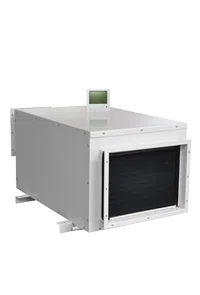
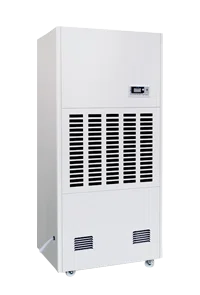
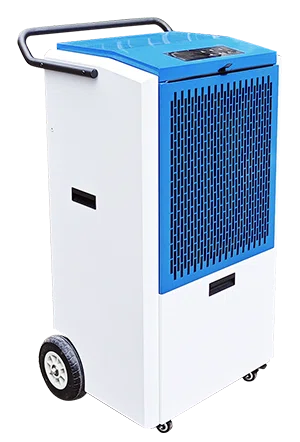
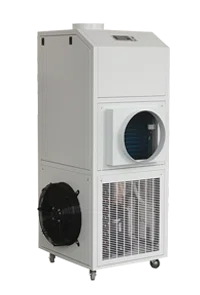
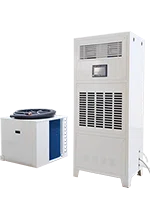
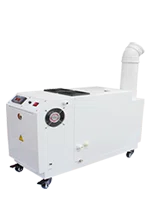
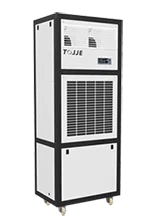
Engineering Stable Environments with Attemperation Dehumidifiers
In many industrial and technical facilities, air is not just “background atmosphere” — it is a critical process parameter. Temperature fluctuations and excess humidity can compromise product quality, damage equipment, and disrupt sensitive operations. This is where attemperation dehumidifiers play a vital role, delivering precise control over both thermal conditions and moisture levels in a single integrated system.
How Attemperation Dehumidifiers Work
The system operates through a coordinated process:
1. Air Cooling & Temperature Moderation
Warm, moisture-laden air is drawn into the system and passed across a cooling coil or heat exchange surface. This lowers air temperature to a controlled level.
2. Condensation & Moisture Removal
As air cools, its capacity to hold moisture decreases. Water vapor condenses on the coil surface and is drained away, effectively removing humidity from the air stream.
3. Attemperation (Temperature Adjustment)
After moisture removal, the air may be slightly reheated or moderated to reach the precise supply temperature needed. This prevents overcooling while maintaining low humidity.
4. Stable Air Delivery
Conditioned air is redistributed evenly, ensuring uniform environmental conditions throughout the space.
This integrated process ensures humidity reduction without uncontrolled temperature drops, which is a common issue with basic dehumidification methods.
Key Advantages of Attemperation Dehumidifiers
✅ Precision Environmental Control
They maintain a consistent relationship between temperature and relative humidity, critical for sensitive processes.
✅ Prevention of Condensation
By controlling both dew point and surface temperatures, these systems minimize condensation on equipment, walls, and products.
✅ Equipment Protection
Reduced moisture means less corrosion, fewer electrical failures, and longer machinery lifespan.
✅ Process Consistency
Stable air conditions support repeatable production results in industries where tolerances are tight.
✅ Energy Optimization
Integrated control reduces the need for separate cooling and drying systems, lowering overall HVAC load.
Where Stable Air Matters Most
Attemperation dehumidifiers are especially valuable in:
- Pharmaceutical and cleanroom facilities – where humidity can affect formulations and sterility
- Electronics manufacturing – to prevent condensation and static-related failures
- Food processing plants – to control moisture, prevent microbial growth, and protect packaging
- Data centers and electrical rooms – to avoid condensation on critical components
- Cold storage and logistics – to manage moisture migration during temperature transitions
Beyond Comfort: Engineering Air as a Utility
In advanced facilities, air is treated like power or water — a controlled utility rather than a comfort feature. Attemperation dehumidifiers transform environmental control into a predictable, engineered parameter, reducing risk and increasing operational reliability.
Attemperation dehumidifiers are more than upgraded air conditioners or standard dehumidifiers. They are precision environmental control systems designed to maintain stable thermal and moisture conditions in demanding industrial settings. By integrating cooling, humidity removal, and temperature moderation, they provide the consistent environment modern processes depend on.